

Episode Notes
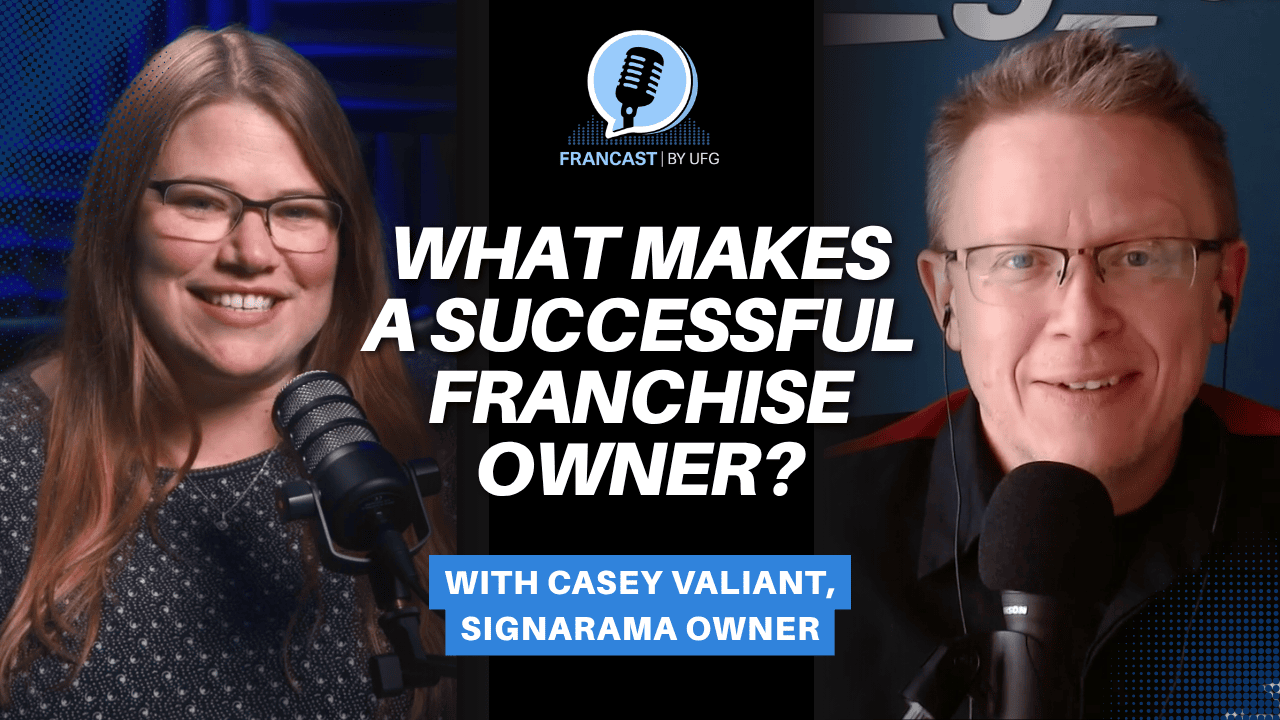
In episode five of FranCast by UFG, the conversation shifts to the franchise owner’s perspective as Mandy Roan, Director of Marketing for Signarama, sits down with Casey Valiant, owner of Signarama Evansville. Casey is a third-generation business owner whose family business dates back to 1957, later converting to Signarama in the 1990s. In the episode, he shares what franchise ownership really looks like, why he sees franchising as a “cheat code” for business ownership, and what it takes to build and grow a business within a franchise system.
Casey also brings a strong track record to the conversation. He and his family were inducted into the Signarama Hall of Fame in 2014, and he was recognized with the Southwestern Indiana Chamber’s 2018 Small Business of the Year award. More recently, Signarama recognized Casey with its 2026 Bill Schwalje Humanitarian of the Year Award.
Throughout the episode, Casey talks about the realities of ownership beyond the product itself, including leading people, developing teams, creating an exceptional customer experience, and making the most of the franchise system around you. He also shares why curiosity, optimism, relationships, and continual learning matter so much in long-term business success.
Be sure to follow Casey and learn more about Signarama.
Featuring
Mandy Roan, Host
Director of Marketing at Signarama
Casey Valiant, Guest
Owner of Signarama Evansville
Episode Transcript
Chad Palmer: 00:09
Welcome to Francast, brought to you by United Franchise Group. I’m Chad Palmer, and today we’re continuing our series on all things franchising with a great conversation from the owner’s perspective. Joining us are Mandy Roan, Director of Marketing for Signarama, and Casey Valiant, the owner of Signarama Evansville in Indiana. Let’s break down what it really looks like to own and grow a franchise. Enjoy.
Mandy Roan: 00:31
Hi everyone. My guest today is Casey Valiant from Evansville, Indiana. Casey, thank you so much for joining us today.
Casey Valiant: 00:38
Absolutely. Glad to be here with you.
Mandy Roan: 00:40
Can you uh give an introduction for our guests and let them know who you are and what your business is?
Casey Valiant: 00:45
Sure thing. I’m uh Casey Valiant from Signarama Evansville, Indiana. I’ve been in business since 1957. Not always this is a Signarama. That came in the 90s, but uh I’ve been in business for a very long time. I’m third generation small business owner.
Mandy Roan: 00:60
Wonderful. Well, thank you so much for joining us today. Uh before we get started, tell us about franchising. Explain it as if you were explaining it to somebody who had no idea what franchising is or what a franchise is.
Casey Valiant: 01:12
Sure. Yeah. Yeah. So the way I look at it, franchising is kind of like a cheat code for business ownership. Um in it’s not a cheat code in the sense that it makes everything easy. You still have a ton of responsibility. You still have to make the thing successful yourself, but it gives you a system to play in. It gives you, it gives you this, this, uh, the these tools to work with. And um it helps you get ahead a little bit faster, uh, but you still have all the work you you have to do.
Mandy Roan: 01:42
And so how did you first get involved in franchising?
Casey Valiant: 01:46
Oh man. So uh I guess my first job was at Hardee’s um and uh just making I I was one of the the people behind the counter. And one summer I was able to be the chicken out in the road um dancing. They dressed me up in the chicken outfit and I got to dance and that was kind of fun. Uh, but anyway, that’s that’s just very early days, right? Um my my grandfather started our business in 1957. My parents took over in the 80s, and then in the mid-90s, we converted our independent sign shop to a Signarama. And uh, and that was our our my first real professional look at uh franchising. And then I came aboard full-time in uh 2006.
Mandy Roan: 02:36
Very good. That’s was there anything that led you guys to look for a franchise for the business versus just continuing to kind of run independently?
Casey Valiant: 02:45
Oh, absolutely. So uh one of the one of the big key factors was we had started as a rubber stamp shop, and we knew my my grandfather started the rubber stamp shop, and and we knew rubber stamps inside and out. I mean we owned that market, we we did really well. But we also saw the writing on the wall in the early 90s, late 80s that rubber stamps were kind of on their way out. So uh many of the rubber stamp shops at the time were either going to the traditional printing route, so they would get offset printers and they would do all that, or they would go into signs. And so my parents decided to go into signs, and they quickly determined that um making something one inch by three inch is vastly different than making something eight foot by four foot or sixteen foot by three foot. It’s uh that there are different technologies, different uh client expectations. So um, as much as I’m confident that they could have figured it out themselves, they chose to say, you know, we need some help, we need some immediate training, we need some immediate infusion of knowledge and expertise. So they looked at all of the available sign franchisees, uh franchise operations at the time, and uh Signarama was the best fit for for what they needed, and um it’s been it’s it’s been the best decision that they’ve made, I think. Besides having me.
Mandy Roan: 04:00
Of course. And rubber stamps, are we still producing rubber stamps today, or is your business kind of shifted to full-on signage?
Casey Valiant: 04:09
We have shifted um 99% to signs. Uh there are still a couple of clients that we do make rubber stamps for, but we uh we have shifted out of 99% of that operation.
Mandy Roan: 04:23
So as a successful um operator today of your Signarama, walk me through what your week looks like.
Casey Valiant: 04:30
Oh man, um I would love to tell you that I it it’s all about signs. My week has nothing to do with signs. Um so we have 16 employees, and the thing that I did not understand in business ownership, even being a third generation uh owner, I it seems like I would have figured this out by now, but uh it’s it’s about the people. Uh I I spend way more time developing people, training people, listening to people, figuring out what their needs are, figuring out what their their bottlenecks are, figuring out what the operations are than anything about signs. I still love the industry. I mean it’s it’s fantastic, wonderful, love it, but I haven’t made it a sign in I don’t know how long. Uh but the the um the development that I’ve been able to do with people, that is just oh, that’s that’s what fills my week.
Mandy Roan: 05:22
So when you say development with people, you’re talking more internally with your team.
Casey Valiant: 05:26
Absolutely. Yep. Yep.
Mandy Roan: 05:28
How have you also had to develop your relationship with clients or um address your business to meet the needs of clients?
Casey Valiant: 05:36
Oh man, that’s a that’s an excellent question. So um one of the things that my my parents taught me early on was uh that you you have to ask your clients what their needs are. So the only reason we started doing signs and not some other industry was when when they were talking to the clients, the clients were asking for banners, the clients were asking for engraved signs, the clients were asking for vehicle graphics, and it’s like, uh yeah, we we can do that. We we don’t know how, but we’ll figure it out. And and so um that’s just been infused in me from a very young age is listening to the clients, understanding what their needs are. But um I I rarely get a chance to do that one-on-one now, and I am able to lead a team that I get to teach that to the team. So it’s kind of a what a fun way to multiply what my parents did through me to the rest of the team and and to have them take up that that just very honorable, very noble um expectation of client relationships.
Mandy Roan: 06:38
Uh looking at your success, looking at kind of the business today, what would you say are two or three behaviors or habits that you have that kind of drive your success?
Casey Valiant: 06:48
Oh man. Um I I think for me personally, continually learning, continually improving, I have always been curious. Um when when I’m interviewing people, um they often ask, what is the what is a trait that would is successful here at Signarama? And uh the answer is always curiosity. If you are not curious about clients and their needs, about how things work, about how things are made, about how things look, about how things are are received, about how things are communicated, you’re you’re just gonna be a robot. You’re just gonna be an uh you’ll be okay, but you won’t really be able to improve the system. You won’t be able to really, really thrive. Um I can I can teach you everything about signs that you would need to know, but if you’re not gonna show the um initiative of curiosity, you’re you’re really hurting yourself.
Mandy Roan: 07:46
Yeah, it’s definitely a trend I see amongst you know franchisees in our space is the curiosity piece, the uh just being coachable piece, and then applying that to your team, like you said. Um when it comes to the business and filling out uh your sales funnel or keeping kind of everything coming for your employees, what are some things that you do to kind of make sure that your pipeline is full?
Casey Valiant: 08:13
Oh, see, I I am at uh I’m at an incredible advantage with this one because I’m a terrible salesperson. So I re I I rely on salespeople. I have to have them because I am I’m just terrible at it. So it has put me in a position where I need to understand how to how to motivate, how to train, how to encourage um and how to hold accountable the salespeople that are are building that that that pipeline in that funnel. So uh we talk a lot about that top of the funnel, we talk a lot about the the bottom of the funnel, getting them to say that final yes, and then repeating the cycle of what does our aftercare look like? What is after the sale is made, what does that look like? Um, do we just ignore them? Do we just completely back off and hope that they call again, or or do we re-engage them in in some uh strategic way? So it’s uh it it has caused me to look at sales in a different way. Um I’m not naturally a salesperson. I’ve never been a salesperson, I don’t have any sales uh background. Um so it it really forces me to um to lead others in that.
Mandy Roan: 09:23
What are some of the things that you’re seeing success with in your local market when it comes to driving sales or having that step above customer experience?
Casey Valiant: 09:34
Sure. Yeah. So uh I’m gonna talk about my parents again, that they were so focused on the customer experience. They they wanted um they wanted the customer experience to be paramount above everything. And one of our core values today is delight the customer. Um, my favorite, absolute favorite book of of all time, business book is Unreasonable Hospitality. And it is it is such a profound look at doing small things to uh small unexpected things to delight the customer in ways that they did not anticipate. Um it doesn’t have to be expensive, it doesn’t have to be flashy, but listening and understanding what their wants and what their needs are, maybe even unrelated to what the job at hand is. But did you did you hear them as a person? Did you connect with them as a human? And those small little points can make such a profound impact on the relationship with the client that um I think that’s where that’s where we really strive locally is is to be that kind of experience for the customer. So um uh we take great pride in in our our Google reviews uh because that’s just kind of a highlight of, yeah, um, these guys are doing it right. And I love it when a review comes in and says, oh, they made it so easy, or I loved working with these guys. They they’re they’re easy to work with, they’re fun to work with. Um, and that’s that that tells me that we’re doing it right. Yes, we do do high quality work. Yes, we get things out on time. Are we easy to work with? Are we enjoyable to work with?
Mandy Roan: 11:09
So continuing on with the theme of relationships, walk me through the relationship between you and the franchisor and how that has been helpful, beneficial in your success.
Casey Valiant: 11:22
Yeah, man, that’s that’s such a good good thing to explore. So the franchisor has really built this beautiful sandbox, and it’s it’s filled with all of the toys, all of the uh opportunities, the relationships, the um the the the webinars, the training, the tools that we need to be successful. How foolish would it be for me to uh stick my face in the sand of that sandbox and expect success? It’s just not wise. So even though this uh sandbox exists, I still have to do something with it. It’s still uh up to me to uh reach out to other franchisees, to reach out to the home office, to uh request training when I need it, to look for those opportunities where I can re-engage with uh with other franchisees who may need my help. Um and if I don’t take advantage of those opportunities, that’s on me. I that’s uh it it’s it’s fully on it’s fully on me for for just not taking advantage of that. So um I would love to say that the franchise or uh guarantees success. It just doesn’t happen. Um nothing can guarantee your own success. And um you you have to work at it, you have to get in there and and uh and make it happen. And they they for the most part have been able to make the opportunity available and allow us to to be successful in that. And it’s it’s just been delightful.
Mandy Roan: 12:58
What curious. What are some of the tools or resources that you find most valuable when it comes to what there is within the franchise system?
Casey Valiant: 13:10
Uh so as I said before, uh, because I’m a third-generation business, we’ve we’ve been in business for a very long time. We were a successful company before we became a Signarama. So my experience and my needs are a little bit different than maybe a brand new entrepreneur who’s never owned a business, who’s never started out. Um so for me, uh the thing that that has proven itself time and time again in its value is that opportunity to connect with other franchisees. So uh a few weeks ago, we just had our our big national convention, SARCON, and I I love going to that. I I don’t think that I’ve missed one in the last 16 or 17 years. And I don’t intend to ever miss one because it is such a valuable reconnection for those relationships, for those people that have helped me when I’ve been in a tight spot, for uh for those people that I’ve been able to help and encourage along the way. And once you have people that you know that are on your side and that that you know that they have their they have your back, it’s it’s so good. It there’s a comfort there, there’s a there’s an encouragement there. There, it it allows me to be a little bit more bold because I I can see what people have done before me and I can have those conversations with them and and we can talk numbers, we can talk shop, we can get deep into the weeds, and they can say, Hey, you’re kind of thinking about this wrong. You need to be thinking about it this way. It’s like, oh yeah. Or they can say, There’s an awesome opportunity in your area, and you’re just not taking advantage of it. You need to look at it this way, and I can come alongside them and do the same thing. And that relationship with those other franchisees is so, so invaluable.
Mandy Roan: 14:56
Your relationship with other franchisees, business owners, but also business owners outside of the franchising space, what would you say are like two or three characteristics that you all kind of share when it comes to being successful business operators?
Casey Valiant: 15:09
Not uh so optimism, not in the sense that everything’s gonna go right, but optimism in the sense that uh I’ll I’ll I’ll be able to figure it out. It’s gonna be hard. I’m I’m gonna make mistakes, but we’re we’re gonna figure this out. We’re we’re gonna figure out a way to do it, to sell more, to grow more, to um serve more. It I I think I think that sense of optimism. Um, I’ve known a couple of pessimistic business owners, and they are miserable to be around. And um it’s it’s painful because you can kind of see the the energy that they zap from other people when they’re in the room. And the the ones that I love being around, the ones that are just energizing, not everything is going right all the time. They’re owning up to their mistakes, but there’s always this optimism, there’s always this expectation of improvement over time. And they’re they’re looking at challenges and they’re figuring out all right, how do I get around this? How do I get through this? How what do I need to do about this? And I think that’s the that’s the thing that that separates uh entrepreneurs, business owners from um the rest of the of the population of just uh I’m I’m just gonna go to work and I’m gonna do my job. Um, we’re not that way.
Mandy Roan: 16:32
Of a little bit of uh resiliency for sure.
Casey Valiant: 16:34
Absolutely, absolutely.
Mandy Roan: 16:37
What would you say is one immediate change that somebody can make in running their business to help them be more successful?
Casey Valiant: 16:45
Um this is gonna be a little bit maybe off topic, uh, but call call that friend, call that person you haven’t talked to in a while. Um, call that other business owner that you used to connect with, but you haven’t. Call them, check on them. Um maybe they’re doing great. Maybe that maybe they just need to hear a friendly voice. Um, maybe you need to hear their friendly voice. Uh I I think I think the human connection, especially as we get into this age of AI, that human connection is going to make or break us mentally. It’s going to be so powerful for our mental health. It’s going to be so powerful for our our our futures, for how we interact with the world. Um retain that human connection.
Mandy Roan: 17:36
I mean, that’s what you said earlier. The relationships are probably the most important thing on both the client side and within the franchise system.
Casey Valiant: 17:44
Yeah, for sure.
Mandy Roan: 17:46
All right. I’m gonna rapid fire. We have about one or two minutes left. I think a couple questions, we’re gonna rapid fire them. Uh the best advice you’ve ever gotten from another franchise owner.
Casey Valiant: 17:59
Action is the antidote of anxiety.
Mandy Roan: 18:02
Best book you’ve ever read.
Casey Valiant: 18:04
Unreasonable hospitality.
Mandy Roan: 18:06
That’s a good one. Uh, what is one personal Casey habit that you protect no matter what the cost?
Casey Valiant: 18:16
I am one of the least habitual people that you will ever meet. Uh but I will I will say this one thing. Um I I make every effort to praise my wife, especially when she is not in the room. Love that.
Mandy Roan: 18:34
Uh one mistake you’re happy that you made.
Casey Valiant: 18:39
All of them. All of them, because every single one of them has has taught me something about other people, has taught me something about myself, even the ones that were just uh stupid things that I should never have even considered doing. I’m I I’m pleased with the the uh the learning that they provided me.
Mandy Roan: 18:60
One last one. What is one tool, resource, podcast book system that everybody should be using if they’re not already?
Casey Valiant: 19:10
Oh man. Um I’m gonna say it’s it’s more of a mindset. Um and and the mindset is this nobody has it all figured out. So if you think that you’re behind everybody, nobody has it all figured out. Just just do the thing. Just get in there and and be ready to make some mistakes and be ready to to figure it out. And and you’re gonna do great. Awesome.
Mandy Roan: 19:35
Well, Casey, thank you so much for sharing all of that with us. It’s always lovely to hear uh your story and your insights, especially uh into the success that you guys have had in your business. So thank you so much for joining us.
Casey Valiant: 19:46
Absolutely. So good to see you again.
Chad Palmer: 19:48
Thanks, Mandy and Casey. At UFG, we really appreciate our dedicated franchisees. If you’re listening and we sparked any questions or got you thinking differently about franchising, that’s the goal of this podcast to help you understand franchising at a deeper level. We’ll be back soon with another conversation breaking down all things franchising. Thanks for listening.
Loved this conversation? Be sure to rate, review, and follow us so you don’t miss an episode! Plus, keep up with us on social media for all the latest updates across the United Franchise Group network.
To email us your questions, you can reach out to [email protected].