

04. How AI Is Changing Franchise Development Marketing
Episode Notes
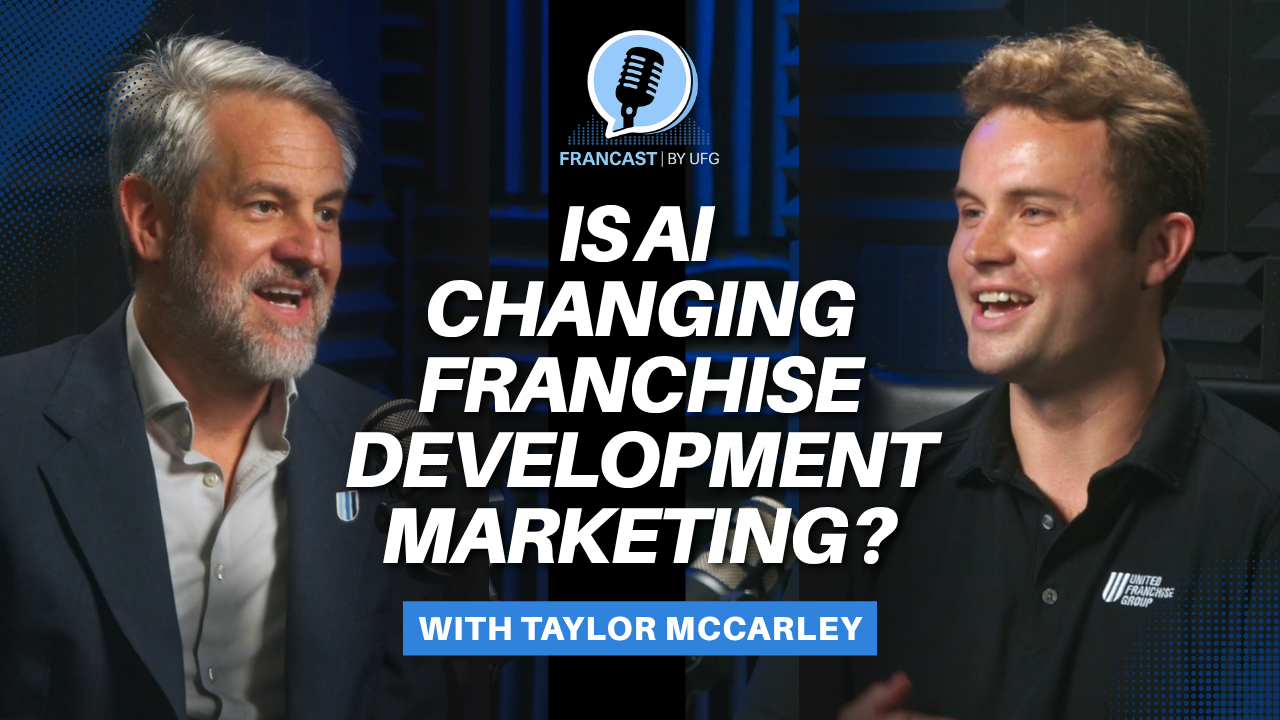
In episode four of FranCast by UFG, host Chad Palmer sits down with Taylor McCarley, Director of Marketing for Black Optix Tint, for a conversation about franchise development, marketing, and how AI is changing the way franchisors attract, qualify, and convert leads. Taylor breaks down the role marketing plays in filling the pipeline, why balancing lead quality and quantity matters, and how franchisors can better position their brands to reach the right prospects.
The episode also explores why brand websites remain such an important lead driver, how CRMs and data help teams measure performance, and what Taylor sees as one of the biggest emerging challenges in franchise marketing: how brands appear in AI search results. He shares practical insight on AI tools, content strategy, automation, and the growing importance of creating marketing that works for both people and AI-powered search.
Taylor also walks through a real example of how automation improved speed to lead, reduced response time, and helped the team book meetings faster, showing how the right technology can create meaningful impact across the franchise sales process. If you’re interested in franchise development, AI, lead generation, or the future of franchise marketing, this episode is packed with timely, practical takeaways.
Be sure to follow Taylor and learn more about Black Optix Tint.
Featuring

Chad Palmer, Host
Chief Growth Officer at United Franchise Group

Taylor McCarley, Guest
Director of Marketing at Black Optix Tint
Episode Transcript
Chad Palmer: 00:09
Welcome to FranCast, brought to you by United Franchise Group. I’m Chad Palmer, and today we’re continuing our podcast on all things franchising, focusing in this interview on franchise development marketing. Joining me today is Taylor McCarley, the Director of Marketing for Black Optix Tint. Thanks so much for being here.
Taylor McCarley: 00:26
Thanks for having me, Chad. Excited to be here. Absolutely. Good to see you again.
Chad Palmer: 00:29
Hey, before we jump in, I would just love for you to share a little bit about your story and uh how you got into franchising.
Taylor McCarley: 00:35
Sure. Yeah. So uh I’ve been with United Franchise Group for a little over four years now. Um, started with Signarama as their marketing manager, then moved into marketing manager for franchise development. And now, as you said, more recently, uh director of marketing for Black Optix Tint. Uh got connected with United Franchise Group because I went to Sanford University in Birmingham, Alabama with Andrew Titus, which, you know, now we have the UFG Innovation Lab there as well. So it’s been really cool to be at a company that only invests in me, but also invests in my university. That’s been great. But yeah, I’ve been here for four years and loved every minute of it.
Chad Palmer: 01:08
All right, great. So for those that are that are new for franchising that might be listening, how how would you explain franchising just in your own words?
Taylor McCarley: 01:15
So I think when you’re thinking about, you know, there’s franchising and there’s franchise development, kind of that subset, right? So franchising as a whole, somebody has created a brand, has a concept, and uh now as a franchise, uh people are able to invest in that, pay the franchise fee to be able to license the brand, get the playbook, the systems, and and have a location uh throughout the country. Franchise development is kind of the subset of working to grow that brand, right, on the sales side. So we’re looking to bring in more franchise owners to own those locations. So that’s kind of how I see both sides.
Chad Palmer: 01:47
So let’s dive a little bit into understanding Fran Dev, which is kind of the the inside lingo short for franchise development. Can you explain uh how how Fran Dev supports franchisors and their marketing efforts and kind of how marketing fits into that overall process?
Taylor McCarley: 02:00
Yeah, sure. So I think on the marketing side, our big goal in franchise development is to make sure that we’re filling the pipeline, right? Um and we’re kind of focusing on two sides. We’re looking at quantity and we’re looking at quality. So we have several lead sources that we work with. We want to be sure that we’re getting enough leads so that our sales team has enough leads to work with, but we also want to make sure that those are uh qualified leads, that the quality of those leads um is strong for our franchise sales team. So we don’t want to just focus on quantity, they’ve got a bunch of leads, but not very good leads, or we’re only focused on the quality side. They don’t have enough leads to have enough activity. We’re trying to find the balance and make sure that our marketing and our messaging, the way that we’re communicating our brands is going to resonate with the right target audience.
Chad Palmer: 02:47
Yeah, I know. I I met with a sales team this morning and it’s the never-ending battle cry of I want quality leads and I want a quantity of them. I want all the quality leads for sure.
Taylor McCarley: 02:56
It’s a never-ending battle. Absolutely.
Chad Palmer: 02:58
So, what what marketing trends are you currently observing uh amongst franchisors?
Taylor McCarley: 03:02
Yeah, I I mean, I think for us, I mean, just what we see here, people are always talking about like, what’s the best lead source? Like, what should I focus on? And I think for us, year over year, even with all the changes that you know, I’m sure we’ll get into like our websites for our brands continue to be our number one lead driver on both sides from a quantity standpoint and a quality standpoint. Um, and so that’s something that we really invest in here. Uh, make sure that the content on those sites we’re regularly updating, making sure that how we’re communicating those brands are going to resonate again with our target audience. But something else that we’ve seen, you know, we we invest in franchise like portals, for example, to list our brands. And one stat that I saw is close to 90% of people, even once they fill out the lead form on the portal, they still go to that brand’s website to verify the information, uh, to make sure that it aligns with what they read, get more details. Um, and so even there, even if it’s not the original lead source, I think it’s still important for franchise brands to make sure that they’re regularly updating that. I’m sure we’ll get into the AI side of all of this, but I think that’s hugely important on top of all of the other lead sources that franchise brands need to invest in to drive quality leads. Absolutely.
Chad Palmer: 04:09
So a perfect segue, you know, both both you and I share a passion and interest in AI. So I would be remiss to ask, like in your opinion, how is AI uh reshaping the marketing strategies for franchisors?
Taylor McCarley: 04:21
Yeah, I mean, I think there’s a ton of opportunities with AI that people need to get into. I think both in things that individual employees can use, and I think even partnerships that we’ve been able to develop as well. Um, I know we we may get into uh some of those that we’ve used for automation, for uh lead bookings and different things like that. But um I think even for us, making sure that you know each team member is kind of expected to be able to do a little bit more now to accomplish a little bit more and that’s possible with AI. But I think one of the traps that people can fall into sometimes is their experience with AI is the free version of ChatGPT or CoPilot because the company pays for it and that’s it. And I think if that’s your experience with AI, whether it’s in franchise development or in any other area in marketing, I think you’re getting a very, very surface level of what actually is possible. There’s so many different things that you can do from a content creation standpoint, even from an ideation standpoint, uh, using it as kind of a thought partner. I know for myself, I use it in a bunch of different ways. Um, even this morning, I was using it just to get ideas for some content creation, building some flyers to promote one of our brands and trying to get a general idea so that I can then go into Canva and build it out that way. So there’s a bunch of different ways to utilize it. I think it’s super important, and I’m sure we’ll dive a little bit deeper into it as we go.
Chad Palmer: 05:38
Absolutely. Let’s switch gears and talk about data and data analytics. So, how crucial do you feel that that data is for franchisors when they’re making marketing decisions? And what are some of the tools that you would recommend?
Taylor McCarley: 05:50
Yeah, I mean, data hugely important, right? I mean, one analogy that has been used a lot here at United Franchise Group is the scoreboard analogy, right? Uh the scoreboard, you know, if we’re playing basketball, for example, and it’s halftime. Uh I’m gonna look at the scoreboard to know where we’re at. Are we are we up? Are we down? If we’re up, do we need to keep doing what we’re doing? If we’re down, what changes do we need to make to make sure that in the second half we are able to outperform and ultimately win that game? And I think it’s the same for us in franchise development and uh looking at our data, you know, for the lead sources that we’re working with, for example, which ones are driving quality leads, which leads are moving through our sales funnel and and which you know, vendor partners maybe are not performing as well as we would have expected. You know, what do we need to change as we move forward uh to make sure that they do perform well, or what changes and adjustments do we need to make in our budgets and our investments to make sure that you know we’re giving our best partners the money that they need to help us get better leads? So um I like to use the scoreboard analogy with our data analytics. Um, and I think the biggest thing that we’re looking at there, our scoreboard is going to be our CRM. Um, so checking out where all of our leads are across our different uh platforms that we use, how many leads have we gotten, how many of those have passed, how many have gone to a first meeting discovery day and beyond. I know for us at the front, we want to be sure that 35% of the leads that we’re getting at least are passing moving forward, 50% of those go to a first meeting all the way through the process. We’ve got percentages that we’re tracking towards every step of the way. And so we want to be sure that we’re checking our scoreboard, our CRM, so that we know that we’re performing at where we need to be. And then, of course, beyond that, different things like you know, Google Analytics, Google Ads, making sure that we’re regularly staying on top of that, holding ourselves, holding our vendors accountable. So there’s a lot of tools. But I think the biggest thing and most important thing to have is a CRM that is showing you the leads as they progress and able to tie that back to the original source.
Chad Palmer: 07:40
Yeah, it’s true. If you’re if you’re using the scoreboard analogy, you can’t win the game if you don’t know what the score is, right? Especially if you’re at halftime and you’re, hey, we need to turn it up, or we need to, you know, turn it up even more. You always want to go up, right? But we got to know where we are, where we are there. Um, so let’s talk about some marketing challenges. So, so what are some uh common marketing challenges that franchisors face and how can they navigate those?
Taylor McCarley: 08:03
Yeah, so I will start and I guess mostly cover the one that everybody is probably thinking about, which is how is my brand appearing in AI? That’s the question I think that everybody is asking. It comes up in all of the meetings that we have with our brands, and it’s important, but you have to make sure that you’re framing it in the right context. So, you know, just from general audience searches, if I’ve heard different stats and numbers on how many people go straight to AI when they’re searching franchise opportunities. I’ve heard it, you know, somewhere from 30, 35% of people start with AI search. I’ve heard it as high as 60, 65%. So there’s some variance in those percentages, obviously, but the fact remains the number of people using AI to search for franchise opportunities is just continuing to grow and it’s only going to continue to grow. I mean, you even see that in in Google search now. It wasn’t too long ago where the first thing you saw were two or three sponsored ads, some organic search results. Now the whole screen is taken over by AI overviews and Gemini. So uh it’s something that we’re all thinking about. It’s something that we’re all trying to stay on top of. And I know for us here, we we use tools now that kind of show us how our brands are appearing. But I think on top of that, again, framing that conversation, when you think about Google search, we always talked about how are our brands ranking? Like, are we in the first spot? Are we on the first page? Things like that. And and there was data that that came out recently kind of talking about how brands appear and how rankings are are kind of tough to track. Um, I think the the stat was, you know, if you did the exact same search, exact same prompt in ChatGPT, uh, less than, you know, one in a hundred times, you would get kind of the same list of brands in order. Uh, and it was, you know, one in like a thousand times if I did that search and wanted to get the exact same list. So what I’ve heard is that it’s less important to track the ranking of an individual brand, and more so how often is that brand just being mentioned in the result, regardless of where that rank may be. Um, so there’s tools now that will kind of run those prompts in the Chat GPTs, the Claudes, the Geminis of the world. And then also give you direction on what are the gaps? Why are we not appearing, or what can we add again to our brand website to help us improve where we’re appearing, or what other sources should we consider looking at to get our content, our brands presented. So I think that’s one of the challenges that I hear people bring up a lot is how do I improve my ranking in AI? And I think it’s less that, and more so how do I improve how often my brand is appearing in those results?
Chad Palmer: 10:28
Yeah, it’s definitely been a tidal wave of change over the last, you know, just over two plus years with ChatGPT kind of changing the game. Uh really interesting to see where we’re gonna be two years from now. Absolutely. We’ll kind of see that. Um, give me an example of a successful marketing strategy that you’ve implemented that’s had a significant impact on one of your brands.
Taylor McCarley: 10:48
Sure. Yeah. So uh, you know, last year, one of the things that we were talking about, and it’s something that we talk about a lot, but speed to lead, right? Like how quickly can we get them from this lead inquiring to us getting in front of them? Because odds are they’re not just looking at one of our brands. They’re probably evaluating several different opportunities, as anyone probably would in that situation. So, what we wanted to do last year is we partnered with a company that actually helps us to text these leads pretty much as soon as they come into our system. So if they come through our brand website, social media, different portals, we have an automated text messaging sequence that gets initiated as soon as they come through. Um, so within you know 30 seconds, they’re getting a text from us thanking them for inquiring about the brand. Uh, but in addition to kind of having that sequence set up, there’s also some AI tools built into it to where it can actually engage with the prospect, answer their questions. And the best part is it can actually help us book appointments with our sales team based on their availability. So the prospect could say, you know, I’m available Wednesday afternoon. It will actually go ahead and book that time on our team’s calendar. And we don’t have to have anyone from our franchise development team, anyone from our sales team involved with that. They just get the meeting booked on their calendar and then jump right into that first meeting. So that’s been really, really helpful for us. We even had some stats. I think last year we had about a 35% response rate through those. And then of those who responded, over half of those actually booked an appointment with us. Um, and then from that, I think I heard that the average kind of time from inquiry to booking an appointment is about four days. For those that actually came through and booked time with us through that system, it was less than 48 hours. So we essentially were able to cut that time in half. And looking at kind of our full sales funnel, we were able to close a significant number of deals just because we used a tool like this, got in front of them quickly, and we’re able to move them through our sales process. Yeah.
Chad Palmer: 12:40
It’s always one of the big challenges because you know, we’re very busy and you know, we have uh, you know, only so many seconds in our days, but prospects, the same thing. They’re busy, so just that connection point of, you know, they want to talk to a franchisor, and the franchisor wants to talk to them. So that technology really is helpful to kind of get that meeting, uh, initial meeting at least in place to start the conversation. Yeah. What other key technologies uh should franchisors prioritize uh to enhance their marketing efforts?
Taylor McCarley: 13:07
Yeah, I I mean again, I’ll I’ll mention a couple tools that we’ve utilized. Obviously, the CRM is super important. Um, you need to have that set up. It is surprising to me how I’ve gone to different conferences over the years and people don’t have a CRM set up or they’ve got kind of a half-baked idea of it. I think that’s super important again, going back to the scoreboard analogy. But I think too, you know, as we’ve had this conversation here, just talking about tracking how your brand is appearing and different AI search results. And then for your marketing teams to make sure that they’re creating content that’s going to help to close the gap across the searches that people are making. What are the content gaps on our website? What are the sources that maybe we need to get more engaged with, more involved with to increase the appearance? And tools exist now to kind of show you where those gaps are. And so it’s important that we’re taking advantage of those, utilizing those so that the people who would be great fits for our brands, we’re getting in front of them with the content that we have available. That’s great.
Chad Palmer: 14:00
So looking ahead, where do you see the future of franchise marketing evolving, particularly with AI?
Taylor McCarley: 14:08
Yeah, I think something that you know we’re starting to see evolve, and I think is only going to become more and more prominent is you know, kind of the whole concept of agents utilizing the internet, right? I think as time goes on, more and more people are kind of having their own agent or agents do a lot of search, research for them. Obviously, Open Claw was a big thing earlier this year, and now we’ve seen platforms like you know, Claude develop their own tools that have more safeguards. But it’s just going to become more and more prominent. It’s just going to become kind of the norm for people to have these agents that go into the research. And so in the past, a lot of what we’ve written to engage our prospects has been written to engage the human side. And that’s obviously still super important, still our number one priority. But obviously, now with the way that these agents can browse the internet, we also need to write our content in a way to where it’s going to see that and then bring those results back to the individual that sent it out to do that research. So now there’s kind of an update in our content strategy. Um, but I think even like on our side, with our marketing team members in franchise development, just across the board, um, I think something that’s super important is just like actively using these different tools and resources that are available. I think it can be very easy to hear leadership at a company, you know, communicate like we need to use AI, we need to be AI first. And, you know, those leaders hope that you then hear that go back and test and utilize these tools, right? Uh but I think the reality is that a lot of people, again, they use the free versions of ChatGPT or they use the one-off co-pilot question. There’s so many tools that are available. Some of them, yes, it’s gonna be a $20 a month subscription. But I think the biggest advice that I could give to anybody in marketing or really anyone in general is find one, whether it’s ChatGPT or Claude or Gemini, whichever one you kind of feel aligns most with your processes, um, pay that $20. And I think you’re gonna find that your output and the results that you get through those channels is just going to improve exponentially. And the more that you work with and utilize those tools for content creation or thinking about different marketing opportunities, or again, as a thought partner, it’s it’s gonna kind of have that better understanding of your role, what you do, what you think is you know good output. Um, and so that’s always my advice. And I think again, what we see just constantly changing, constantly evolving is having these AI tools help you accomplish more than you can just on your own.
Chad Palmer: 16:29
Yeah, I I would agree with that. I would say also, I know we’ve talked about this in the past, but the more you use these AI tools, the better they get because they learn you, they learn your brand. And the the kind of more information you can feed them, the better the result gets on the on the tail end. So we’ll kind of close it with any exciting tools, uh any kind of fun AI stuff that you’re playing with you could uh let the audience know about.
Taylor McCarley: 16:52
Yeah, I mean, I’m always trying to test and and utilize different tools for a long time. I know I mentioned ChatGPT several times. That was my go-to, as I’m sure it was the majority of people’s. Uh over time we’ve had other tools like the Perplexities of the world, Gemini, Claude obviously is becoming more and more uh utilized. And that’s kind of been my default now. Um, I think at the time of this recording, they just had a brand new model come out four days ago, five days ago. So now they’ve got Opus 4.7. I think with that, I ironically, I have found I still prefer Opus 4.6. I think 4.7 is really good at data analysis. It’s really good at like direct kind of business style communication, which is helpful in some instances. But I think Opus 4.6 has been really, really good at kind of the storytelling side. I think just from a content creation standpoint, it does a better job of communicating how I would prefer to communicate. Again, that’s one of those things that you just kind of figure out as you use these different tools which ones align with your communication style, the goals of your output. But I think even beyond that, you know, things like image generation, I find that Gemini is typically my go-to when I’m trying to create uh just ideas. Like usually it’s not my final output. But again, if I’m trying to work on some different marketing collateral, I need some initial ideas, I can upload our brand guidelines, I can upload some uh examples that I’m looking for, and it can give me an output that I can go replicate. Uh, we’ve had instances where maybe we need to swap a logo in some images. Uh ChatGPT, ironically, has been pretty good at that for me. Uh, let me see which uh what else I’ve used. Um, Grok is not one that you hear referenced too often, but I have used it in some cases when I need to maybe animate an image. Um, I’ve also used tools like Suno for music. I’ve used Eleven Labs for uh voiceover. We can even use a microphone like this and then actually tweak the voice so that it aligns closer to change the brand. Exactly. And we can do whatever we want. So there’s a lot of tools. There’s a lot of resources that are out there and available. Last one I’ll mention uh Notebook LM, I think it’s forgotten a lot. It’s another Google product. Um obviously we mentioned at the beginning, recently moved over to Black Optix Tint on their marketing team. I wanted to have a better idea of you know the industry, the brand. Um, so I went online, I collected a bunch of resources. I ran some deep research prompts while I was on vacation for a holiday weekend. And on the way back, I threw all those sources into Notebook LM, had a 45-minute podcast created about all of that that I could just kind of listen to as I was driving back. So there’s a bunch of different tools, a bunch of different resources to utilize. I always default to Claude first, but as you can see, there’s a lot of other options that are available. Yeah.
Chad Palmer: 19:36
And I I think Note Notebook LM kind of got swept under the carpet at some point. It seems like it’s just gotten better and better for those of us that use it. Especially like that case scenario for general education. Just throw a bunch of websites, YouTube videos, put everything in there and have it spit out. Yeah. The information’s great. Absolutely. Okay, well, Taylor, thanks so much for joining us today and sharing your experience and perspective. Uh, if you’re listening, we sparked questions that got you thinking differently about franchising. That’s the goal of this podcast. Really just to help you understand franchising at a deeper level. We’ll be back soon with another conversation breaking down all things franchising. Thanks for listening.
Loved this conversation? Be sure to rate, review, and follow us so you don’t miss an episode! Plus, keep up with us on social media for all the latest updates across the United Franchise Group network.
To email us your questions, you can reach out to [email protected].